Pole Position: Preparing for the Agentic Era of Telco Delivery
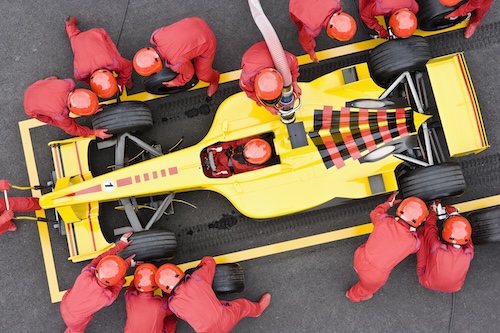
Agentic AI strengthens HIETs by extending their capacity, rather than displacing their expertise. By reducing friction and increasing analytical depth, agentic AI allows HIETs to focus their human ingenuity where it matters most; on solving high-value problems, innovating at speed, and driving measurable business outcomes.

This is part three of our 'IT transformation in telco' series. Please click on the following to read part one or part two.
In motorsport, races are not just won out on the track. They are also won in the pit lane, where highly specialized teams work under extreme pressure to perfectly execute choreographed actions in seconds.
Today, execution excellence is also mission critical for telecommunications companies – complexity is growing, customer expectations are rising sharply, and technology cycles are accelerating. As a result, agile ways of working are no longer optional, but agility alone is not enough.
What truly matters now is how teams are assembled and how they work together. This is where High Impact Engineering Teams (HIETs) come into play.
Introducing High Impact Engineering Teams
Traditional telco delivery models are often built around functional silos. The business defines requirements, IT implements, testing validates, and operations handles deployment. While this approach optimizes specialization, it also introduces handovers, delays, and misalignment. Iteration cycles stretch into months, and quality issues surface late.
HIETs break with this traditional logic. A High Impact Engineering Team is a cross-functional, long-lived team that owns a product or capability end-to-end. Business and technology roles are integrated into a single unit, enabling decisions to be made where the work happens and dependencies to be resolved in real time. Instead of managing across silos, accountability is embedded within the team. In that sense, HIET can be seen as the natural evolution of BizDevOps – think of it as BizDevOps on steroids: more ownership, more autonomy, and sharper outcome focus.
In motorsport terms, a HIET resembles a modern pit crew. There is no sequential escalation across departments. The team operates as one synchronized unit – planning, building, testing, and delivering in a continuous flow. Every role is specialized, but performance emerges from coordination, not hierarchy. The result: speed, precision, and the ability to adapt instantly when conditions change.
The HIET Toolbox
Having helped numerous telco players to successfully build HIETs, we have defined the six essential requirements:
- Product ownership is the first, because it is essential for defining value, priorities, and outcomes. Good product leadership ensures that every increment delivers measurable business value. The product owner defines the vision, manages trade-offs, and aligns stakeholders around a clear outcome – providing direction while preserving team autonomy
- Deep business expertise is vital for anchoring development in real operational needs. Subject matter experts and business analysts translate operational realities into structured requirements, ensuring development remains aligned with regulatory, commercial, and process constraints in telco environments
- Architecture and engineering to ensure technical integrity and execution excellence. Long-term coherence, scalability, and integration are all underpinned by architecture, and engineering rapidly translates strategic thinking into software. Developers are the team’s execution engine, writing production-grade code, refactoring continuously, and embedding quality from the outset. Continuous integration, automated testing, and CI/CD pipelines are at the heart of this role, enabling frequent, reliable releases while safeguarding architectural stability
- Design and UX to shape intuitive customer experiences. Functionality alone is not enough; high levels of usability are also critical to modern journeys – designers align product intent with customer interaction to create truly intuitive flows (and design systems that evolve alongside the product)
- Quality engineering and testing embedded throughout development. Rather than being treated as just another downstream checkpoint, maintaining quality must become a continuous discipline. Test automation, integration testing, and end-to-end validation need to be embedded into daily workflows to prevent unwanted late-stage surprises
- Agile leadership to maintain flow and discipline. Scrum masters and other agile leaders are needed to facilitate alignment, to identify and remove blockers, and to generally make sure delivery flows are rhythmic and transparent
When a HIET is equipped with this set of skills, we have seen delivery cycles shrink from months to weeks. Quality is maximized because it is built in from the start (rather than inspected at the end), contrasting what we see from traditional, siloed delivery models. But assembling your HIET is just the beginning.
Agentic Acceleration
Even the best human pit crew has limits. As telcos target increasingly AI-driven operations, human cognitive and execution capacity is becoming a constraint.
Planning, prioritization, design iteration, testing, and deployment now need to be conducted in parallel, and at a pace that stretches traditional sprint-based models and capabilities to their limits.
This is the point at which agentic AI enters the picture – not as a replacement for skilled human teams, but as an augmentation that takes HIET capabilities to even greater heights. For perspective, Figure 1 compares the performance of legacy teams and agentic pit crews:
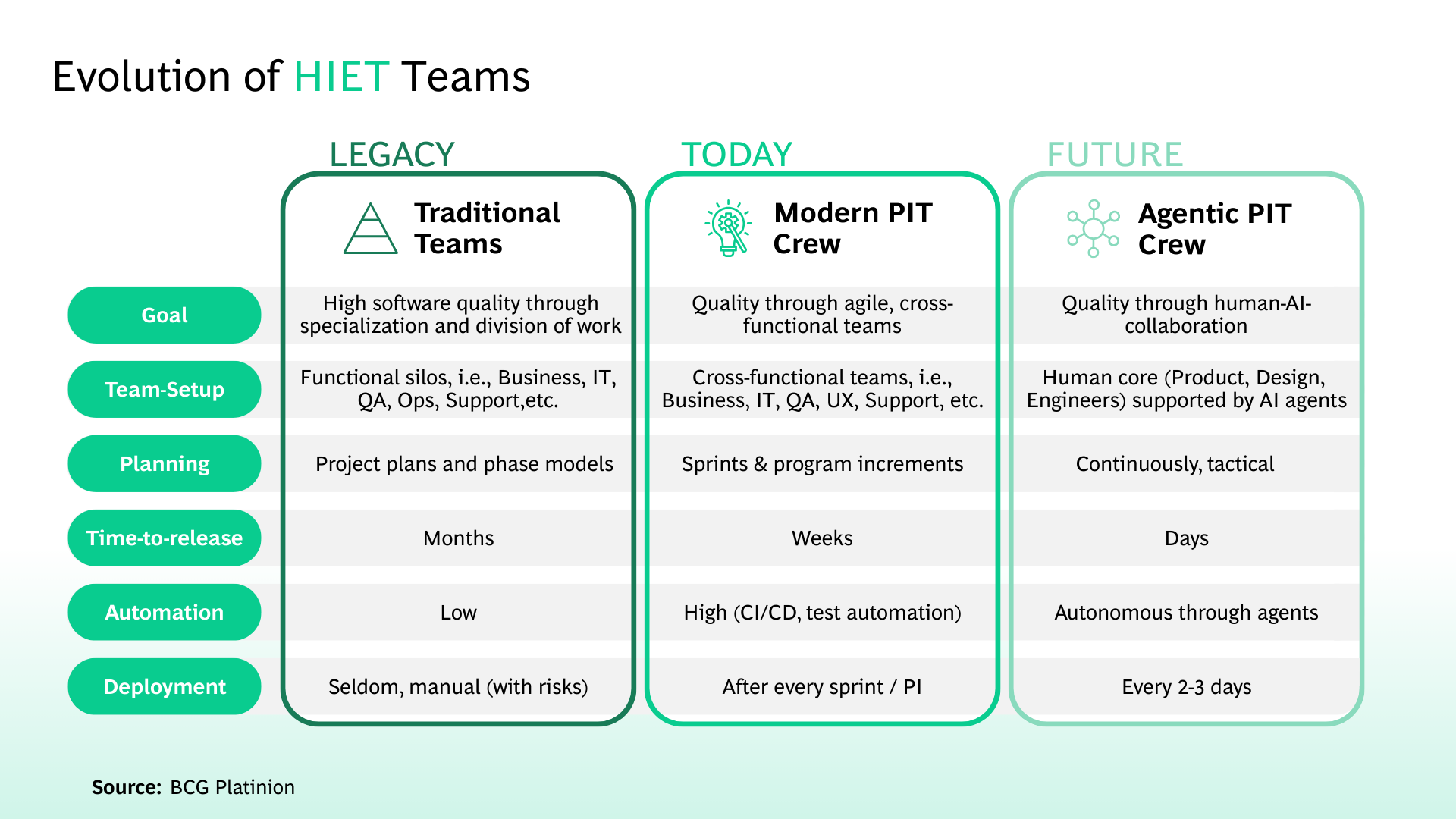
An agentic HIET is a deliberate partnership of human judgement and machine autonomy, this approach involves a simplified core human team divided into three focus areas: product, design, and engineering. The result is an agentic HIET – humans remain fully accountable, but what changes is how they operate.
Figure 2 provides a side-by-side comparison that highlights the key aspects of this evolution – from the shift to small, agentic HIETs, to the advantages of a continuous, agent-orchestrated flow.
.png)
How are the roles of human players in these small agentic HIETs augmented by specialized AI agents?
Agentic support for product involves AI being used to continuously analyze customer data, usage patterns, and delivery signals. It then proposes value-adding backlog refinements and priority shifts in near real-time.
For designers, agents help by generating and testing UI variants, validating accessibility and consistency, and by compressing weeks of iterations into just hours. Crucially, human designers remain the custodians of overall user experience.
Engineers retain architecture ownership while agents generate scaffolding code, write and execute tests, detect regressions, and automate deployments. The result is accelerated execution without compromising on control.
Together, humans and agents form a new kind of pit crew: fewer manual bottlenecks, more leverage, and dramatically increased execution capacity.
Shifting Gears: From Sprints to Continuous Flow
The scaled, agile setups we see today often use structured planning cadences for synchronization. These typically take place every 8 to 12 weeks and align teams through shared objectives and dependencies – an approach that made sense when humans performed most of the planning and execution tasks.
When using an agentic HIET setup, synchronization becomes continuous:
- Agents monitor dependencies, risks, and capacity across teams in real time
- Planning horizons shrink from weeks to days
- Deployments no longer wait for sprint or increment boundaries – they can occur every 2 to 3 days once validated via automated quality gates and architectural guardrails
Humans navigate intent, priorities, and constraints. Agents handle orchestration and execution speed. The rhythm shifts from episodic coordination to continuous alignment, much like a race team constantly optimizing lap by lap (rather than waiting for scheduled pit stops).
Scaling the Model: Orchestrating Many Agentic HIETs
As organizations scale, the question of how many HIETs are needed (and how to orchestrate them) becomes relevant. Rather than relying solely on sprint-level planning artifacts, telco operators can leverage established industry capability models. Examples include TM Forum-aligned process landscapes and customer journey-based capability frameworks, which offer effective ways to structure delivery organization.
These models provide clear ownership boundaries across journeys and operational domains, and a basis for determining how many HIETs are required. They also serve as a structural backbone that prevents fragmentation as speed increases.
In an agentic HIET setup, capability models no longer dictate detailed sprint content. Instead, they serve as organizational scaffolding – ensuring acceleration does not compromise architectural coherence.
Orchestration shifts toward continuous portfolio-level steering, supported by AI-driven dependency analysis and reviewed by human leadership.
The Finish Line is a Moving Target
Telco companies that establish modern, agentic HIETs will overtake those still using traditional delivery models. They create the structural foundation for faster alignment, clearer ownership, and improved execution.
Looking ahead, Agentic HIET teams can be seen as a practical step toward what BCG Platinion frames as the 'dark software factory' for software delivery—a model in which large parts of the development lifecycle operate with minimal manual intervention. While this vision remains largely aspirational in telecom, agentic teams already embed the core principles of this model, such as increased automation and a continuously running delivery system.
Innovation starts in the garage when it comes to motorsport, long before its impact is seen on the leaderboard - tomorrow’s top telco IT teams will follow suit. Building HIETs is a fundamental part of this evolution, but truly agentic HIETs will enable telcos to lap competitors that lag behind.
To find out more about how we are helping telecoms players to do this, get in touch with our experts listed below.